Showing posts with label CyBER-BlackSEC. Show all posts

11 May 2012

PIERLUIGI PAGANINI: Anonymous Reloaded. Yesterday, today, tomorrow

-Cyber-BlackSEC- OPEN SOURCE
US/1; ATTN: PA/2; IT/2; US/12

[ed.note: Please see US/1 note, below…]

by paganinip on May 4th, 2012
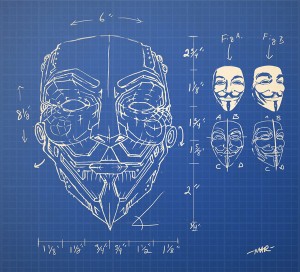
The word “Anonymous ” evokes the myth of the hacker in today’s society that defends freedom of expression and agrees with sensational cyber operations in the fight against censorship and government and industrial questionable policies.
better_anonymous

If Anonymous is perceived by future generations as an attractive ideology to follow, industry and government view with concern the threat posed by the group’s operations. The recent security reports, such as that produced by Verizon, indicates the phenomenon of hacktivism as the main threat of cybercrime planet, estimating the damage done by groups like Anonymous in their frequent operations.
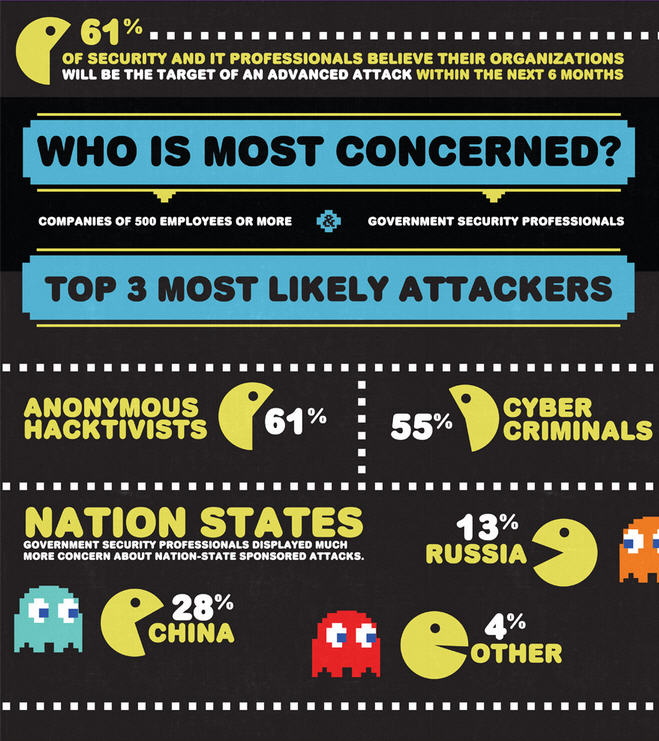
The majority of IT and security professionals is convinced that Anonymous and groups of hacktivists are main cyber threats able to attack their organizations impacting on their primary business. Around the 64% of the nearly 2,000 IT professionals who participated in Bit9′s 2012 Cyber Security Survey believe that their companies will be target of a cyber attack during the next six months and 61% of them chose hacktivists as the likely attackers.
Of course the main factor exposes companies to the threat of the group is their media exposure, the participation to the policies or international public debates on new regulations. The group has demonstrated, in my opinion a great consistency in his choice of targets, offending companies that have distinguished themselves in approaching the topics so controversial that the group is interested.  No one can be considered safe, from the provider who is willing to support the new regulations such as the Cyber ​​Intelligence Sharing and Protection Act (CISPA) to the government agency intents on pursuing questionable international policies.
But which is the method of attack that most scares the companies?

Despite the companies afraid Anonymous and hacktivism they are most worried by the usage of malware as cyber weapon instead of the classic Distributed denial-of-service (DDoS) and SQL injection attacks preferred by the notorious hackers.
On this data we can make a couple of interesting reflections:
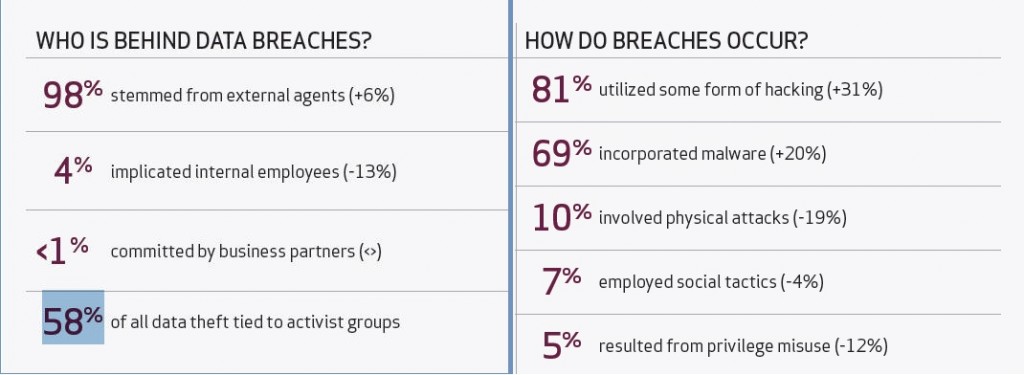

Companies are scared of hacktivism but consider its mode of attacks not so dangerous. The fear on anonymous attacks is related to the media effect of its operations that could damage the image of the business and also to attract other criminals groups on the target.

Second point, it is expected a radical change in the modus operandi of the Anonymous group because it is attracting also many hackers and professional that are interested to its operations. The skill of the hackers is increasing and the imminent risk is that a 0-day vulnerabilities could be found and exploited by the hacktivist causing extensive damage. The scenario described is not so absurd, let’s consider in fact that many operations of the groups could be shared and approved directly by government groups of hacker under coverage. In this case the power of attack of the group could be amplified. Let’s consider also that there is the high risk of infiltrations of the groups, Anonymous could be compared to a powerful cyber weapon. In that case operations could be addressed against political targets.

Many experts are sure that behind the recent attacks to China and it’s Great Firewall there is also the support of western intelligence, same scenario in Syria and in Tibet where groups of hacktivist have provided technological support to the dissidents.
Anonymous, and foreign governments, are well informed on the impact that political scandals could have on a country like China, emblematic is the case of communist party politician Bo Xilai.

[And Julian ASSANGE’s “thermo-nuclear threat” against Rupert MURDOCH and NEWS CORP. – US/1]
Xilai, the former Chongqing party chief, was removed from it engagements in his party positions last week because with his wife, Gu Kailai, are being investigated over the murder of British businessman Neil Heywood. The news has a dramatic effect on Chinese Public opinion, for this reason immediately the government has increased the monitoring of the social media to contain the diffusion of the news. 

On the other side, groups related to Anonymous have started to attack principal government web sites trying to force the censorship wall. Just for information searches for both Bo Xilai and his wife’s name were quickly blocked on Sina Weibo, and mass censorship of comments began.

What we expect from Anonymous in the future?

Nobody in technology, nor in business, could ignore the cyber threat moved by the group and must consider it in its cyber strategy. In the same time the group have to increase its  operations and their media effects choosing more striking objectives and conducing attacks able to make more and more damage. Next steps will include most advanced attack methods such as creating malware that to exploit unknown vulnerabilities.

Anonymous must be analyzed with a multidisciplinary approach, it is an amorphous creature that quickly changes and is able to adapt its behavior to the context he need to attack thanks the large and heterogeneous participation in its collective. But do not forget that “Anonymous” due its notoriety has become the perfect scape goat, government and private industry can perform cyber attacks in the name of the groups involving critical masses.

We run the serious risk of being frightened by the entity directing our efforts against the wrong image reflected in a mirror, the result of diversions or worse of an undercover action. In my opinion this is the most disturbing aspect of the story.  How to avoid this? It’s hard to say, it is impossible to hazard a forecast. Personally, if I were part of the collective, I would begin to evaluate a social opening considering that the movement is also expression of large masses.

That is the real challenge for a movement that may die due its notoriety, but consider that the outing isn’t so simple because Anonymous has no unified voice and hasn’t a real control center.

The choice could actually split the group, giving rise to crazy cells,
impossible to control and very dangerous.

Pierluigi Paganini


[Information contained in BKNT E-mail is considered Attorney-Client and Attorney Work Product privileged, copyrighted and confidential. Views that may be expressed are those of the author(s) and do not necessarily reflect those of any government, agency, or news organization.]
 

30 April 2012

Pierluigi Paganini: Fear Iran and escalation of cyber attacks


 - OPEN SOURCE
IranianCyberWar/LinkedIN; US/1; ATTN: IS/[redacted], HD/23; HST/2; Mil.COM/2; US/17     Member CONTRIBUTION

by paganinip on April 30th, 2012

Last week I reported the virus attack to the Iranian oil industry, a cyber attack that seems has caused few damages but that raised again the theme of cyber warfare. Oil industry is the primary economic business of Iranian Government and an attack to the sector appears to the experts as a cyber war acts. In the past Iran was already victim of cyber attack to its nuclear plants, we all remember the case of the Stuxnet Virus, for this reason the Iranian intelligence is convinced that also this time the nation is facing with a new cyber attack. Iran has in great consideration the theme of cyber warfare and it government is making big investments to strengthen the technological structure of the country and to promote effective cyber strategy.

Immediate reaction to the incident, on Saturday Iranian oil ministry’s cyber team has identified the targets of the attack and also the responsibles. Despite the Iranian officials haven’t revealed the identity of the responsibles they have provided more information regarding the attack and the real damages, they have in fact confirmed a virus has hit the structures of Kharg Island plant destroing minor data and some user’s hard disks. For all the data infected the experts have a copy of backup that has been restored without problems.

“The nature of the attack and the identity of the attackers have been discovered, but we cannot publicize it since we are still working on the case,”

Deputy Oil Minister Hamdollah Mohammadnejad told FNA.

“the attack was carried out by virus penetration and was aimed at stealing and destroying data and information.”

The spokesman’s words are eloquent, the attack hasn’t had the sole intent to destroy data, but it is part of a complex strategy that aims to infiltrate the Iranian networks gathering sensible information.

“those who design and develop such viruses are pursuing specific goals”.

Obviously there is the announcement in tones of propaganda immediate resumption of operations at the site attacked, senior Iranian oil ministry officials announced earlier this week said their computer systems resumed normal operation on Wednesday.

Iranian Oil Ministry’s Spokesman Alireza Nikzad-Rahbar declared that main services of the ministry’s computer systems, including the Administrative Automation System were up again on Tuesday evening, and that all the Iranian government experts have adopted all precautions to minimize the impact of a cyber attack ensuring the business continuity.

Iranian government is aware of the destructive capabilities of cyber weapons and the importance of appropriate cyber strategy, rather it is believed that in this area, the Western enemy may be more vulnerable. On March 2012 the leader of the Islamic Revolution Ayatollah Seyyed Ali Khamenei has tasked Iranian President Mahmoud Ahmadinejad with the duty of establishing a Supreme Council of Cyberspace which is charged with protecting the Iranian cyberspace

The registered attack is not the only one against Iranian infrastructures, Iranian Sharg newspaperhas reported that hackers have attacked the computers of Iran’s ministry of science, of course also this time there aren’t damage. Iranian expert also in this occasion have noted that the hackers haven’t the only purpose to destroy data but they were more interested to steal information.

An analysis of activities in cyber space clear the escalation of cyber conflict in the Middle East with Israel as the main protagonists, and the emerging Iran and Lebanon. The detailed Middle East Cyber War Timeline is available on the web site of the collegue Paolo Passeri, following a brief list of the events.

The intensification of the attacks provides an indicator of the level of tension in the area, and portends a military intervention to date avoided only by the veto of countries like China and Russia backing the government in Tehran. The intense activity also impacts on the policies of leading western nations, U.S. in the lead. 

The Iran issue is beginning to worry the American government, and not only, that through a media campaign is trying to rally support for military intervention in the area. Attempts of diplomacy did not match the expected results allowing the government in Tehran to organize an alarming strategy. Recall that world experts believe that Iran can have its own nuclear arsenal within two years, this time the West will have to decide how to act and precede.

Very significant is the report “The Iranian Cyber Threat to the U.S. Homeland” Statement before the U.S. House of Representatives Committee on Homeland Security Subcommittee on Cybersecurity, Infrastructure Protection, and Security Technologies and Subcommittee on Counterterrorism and Intelligence. In the document are analyzed the growing Iranian capabilities, the country expanding exploitation of cyberspace can be attributed to two principal geopolitical drivers:
  1. The first are the Iranian regime’s efforts to counter Western influence and prevent the emergence of a “soft revolution” within its borders. That digital barrier has grown exponentially over the past three years, as Iran’s leadership has sought to domestic dissent and curtail the ability of its opponents to organize.
  2. The second geopolitical driver of Iran’s interest in cyberspace relates to the expanding conflict with the West over its nuclear ambitions.
The report clarify the position of Teheran that is considering itself engaged in a cyber war with West, due this reason the Iranian regime is mobilizing in response launching an ambitious $1 billion governmental program to boost national cyber capabilities, acquiring new technologies, investing in cyber defense, and creating of a new army of cyber experts.

Where does the United States stand with regard to a response? The Obama administration has made cybersecurity a major area of policy focus since taking office in 2009, and the past year in particular has seen a dramatic expansion of governmental awareness of cyberspace as a new domain of conflict.

The U.S. government, in other words, has not yet even begun to get ready for cyberwar with Iran, and according the report it’s time to start it. The risk of attacks against infrastuctures located in US homeland is high and it will increase in coming months due a range of scenarios, from a renewed diplomatic impasse to a further strengthening of economic sanctions to the use of military force against Iranian nuclear facilities.

Never let the guard down!

Pierluigi Paganini

[Information contained in BKNT E-mail is considered Attorney-Client and Attorney Work Product privileged, copyrighted and confidential. Views that may be expressed are those of the author(s) and do not necessarily reflect those of any government, agency, or news organization.]

15 July 2011

CyBER-BlackSEC--EPIC v. NSA; VC/JCS v. DepSECDEF--OS


VS/2; US/1; ATTN: US/12; JAG/1; HST/2; JAG/5
EPIC v. NSA: Agency Can "Neither Confirm Nor Deny" Google Ties

A federal judge has issued an opinion in EPIC v. NSA, and accepted the NSA's claim that it can "neither confirm nor deny" that it had entered into a relationship with Google following the China hacking incident in January 2010. EPIC had sought documents under the FOIA because such an agreement could reveal that the NSA is developing technical standards that would enable greater surveillance of Internet users.

The "Glomar response," to neither confirm nor deny, is a controversial legal doctrine that allows agencies to conceal the existence of records that might otherwise be subject to public disclosure. EPIC plans to appeal this decision. EPIC is also litigating to obtain the National Security Presidential Directive that sets out the NSA's cyber security authority. And EPIC is seeking from the NSA information about Internet vulnerability assessments, the Director's classified views on how the NSA's practices impact Internet privacy, and the NSA's "Perfect Citizen" program. 

Tags: Google NSA NSPD54 Privacy
- OPEN SOURCE
-------------------------------------------------------|
CBS News Exclusive on US Cyber-WAR Center:


U.S. cyber approach ‘too predictable’ for one top general

By Ellen Nakashima, Published: July 14, 2011

The nation’s second-ranking military official said Thursday that the U.S. approach to protecting its computer systems was “too predictable” and failed to penalize attackers, comments that preceded the release of a Pentagon cyber strategy that emphasized defense over retaliation.

“We’re on a path that is too predictable, way too predictable,” Gen. James Cartwright, vice chairman of the Joint Chiefs of Staff, told defense reporters Thursday. “It’s purely defensive. There is no penalty for attacking us now. We have to figure out a way to change that.” 

Hours later, Deputy Defense Secretary William J. Lynn III presented a strategy whose thrust, he said, is defensive and focused on “denying the benefit of an attack.”

To illustrate the growing threat, Lynn disclosed that in March, the Defense Department discovered that a foreign intelligence service had hacked into a defense contractor’s system and stolen 24,000 computer files related to a weapons system under development, one of the largest known cyberattacks targeting the U.S. military.

Lynn did not name the contractor or the government behind the intrusion but said the Pentagon was reviewing whether the weapons system needed to be redesigned.
The Defense Department’s newly unveiled strategy relies on deploying sensors, software and special signatures, or lines of code, that detect and stop intrusions before they affect operations.

“If an attack will not have its intended effect, those who wish us harm will have less reason to target us through cyberspace in the first place,” Lynn said.
Defining an act of CyBER-WAR, VC/JCS Gen. James Cartwright said during a recent press conference on the subject: “it’s in the eye of the beholder.”
Cartwright, in his remarks to defense reporters, suggested that stronger deterrents would be needed. “We are supposed to be offshore convincing people if they attack, it won’t be free,” he said, adding that adversaries should know that the United States has “the capability and capacity to do something about it.”

Cartwright, who appeared with Lynn at a news conference after the strategy rollout, described the cyber plan as a first step. “This starts us down the path of building out both our defenses and our awareness skills,” he said. Eventually, he added, more aggressive cyber tactics, as well as legal and diplomatic measures, would be needed to “raise the price” of attacking. 

Over the past year, President Obama had asked Cartwright several times whether he would be willing to become chairman of the Joint Chiefs of Staff, The Washington Post reported in May, but Obama later turned to another candidate. Cartwright is leaving office this summer.

Stewart A. Baker, a former National Security Agency general counsel, in a blog post likened the Pentagon’s new cyber plan to a nuclear deterrent strategy of building more fallout shelters. “This is at best a partial strategy,” he wrote. “The plan as described fails to engage on the hard issues, such as offense and attribution and, well, winning.”

Rep. Jim Langevin (D-R.I.), co-founder of the Congressional Cybersecurity Caucus, said that the plan was a good start but that key areas were missing. “What are acceptable red lines for actions in cyberspace? . . . Does data theft or disruption rise to the level of warfare, or do we have to see a physical event, such as an attack on our power grid, before we respond militarily?”

Lynn said that the United States has not yet been hit by an act of cyber war and that there was deterrent value in remaining ambiguous about what would constitute one. But ultimately, he said, it is the president and Congress that would decide that the human or economic damage is severe enough to consider a cyber event an act of war. He said the Pentagon would take the lead only if, in the “judgment of the leadership of the country, it required a military response.”

Cartwright, at the news conference, said the disabling of computerized patient records at a hospital such that the patients cannot be treated would be a violation of the law of armed conflict. “Then you have proportional responses” that can be undertaken, he said, without specifying which or by whom.

But when it comes to an act of war, he said, “it’s in the eye of the beholder.”

Staff writer Jason Ukman contributed to this report.
© The Washington Post Company

 CONTINUE Reading FULL STORY HERE...

CyBER-BlackSEC Debate

BlackNIGHT Target Practice

SEAL Team SIX - Iron Will from CBS News

The Devil's Advocate?

In 1991, [the late former Secretary of State Lawrence 'Just call me George'] Eagleburger explained to The Post why all of his sons were named Lawrence.

“First of all, it was ego,” he said. “And secondly, I wanted to screw up the Social Security system.”