14 May 2012

CNN.com: Yemen plot exposes new world of U.S. spying


OPEN SOURCE
US/1; ATTN 


By Pam Benson
CNN.com - 11 May 2012
As details of the foiled al Qaeda plot to blow up a U.S.-bound airline became public, the world learned not only about a daring operation to stop terrorists, but also about the new reality of how U.S. intelligence works.

American and foreign intelligence partners working hand in hand to rid the world of the scourge of terror. You didn't see much of that 10 years ago, but it's exactly what happened recently.

The Saudis infiltrate an al Qaeda terrorist group in Yemen with their own mole, and the CIA and others are brought into the mix to help run an operation that eventually foils a possible bomb attack against an airliner destined for America.

"I'm not at all surprised that the press accounts of this have liaison services, particularly the Saudis, playing such a prominent role," said former CIA Director Michael Hayden. "That's the way I would have expected it to go."

The terrorist attacks of September 11, 2001, changed everything in the American intelligence community. It drove home the point that the Cold War was over. The battlefield looked quite different and the United States wasn't quite prepared.

It no longer sufficed to have satellites stare down at a static enemy behind the Iron Curtain, with tens of thousands of troops separating the Soviet Union from Western Europe.

The enemy became terrorist groups that for the most part hid in safe havens and operated from ungoverned territories seemingly out of the reach of traditional intelligence and military responses.

"The ability to penetrate a terrorist organization is an incredibly difficult task that we were poorly positioned to do in the 1990s and even a few years after 9/11," said Amy Zegart, a senior fellow at Stanford University's Hoover Institution and an expert on the intelligence community.

It has been an arduous task and it is far from complete, but Zegart believes U.S. efforts to bolster human intelligence capability and work much more closely with foreign intelligence counterparts are paying off.

Former FBI agent Ali Soufan told CNN the joint intelligence operation was as good as it gets.

"You have a place like Yemen. You have al Qaeda, CIA, you have other friendly intelligence agencies. You have a source inside. It doesn't get any better than that," he said.

And the operation turned out to be a twofer - that is, the mole not only secured the new generation bomb and helped get it out of Yemen, but he also helped identify the location of a senior al Qaeda operative in Yemen, enabling the CIA to use one of its other more recent tools, the armed drone.

Just about everyone CNN has spoken with within the intelligence community touts the value of the drone missile strikes. The program began in the Bush administration to target al Qaeda leaders in the tribal regions of Pakistan and has expanded extensively under President Obama. Terrorism experts including CNN's Peter Bergen agree the program has been extremely effective.

"The drone strikes are not just important in terms of eliminating the leadership of al Qaeda," Bergen said. "They are also important in terms of preventing people from training in the tribal region and making that very difficult because you are always looking over your shoulder for a drone attack."

Now drone strikes are being used far more extensively in Yemen, particularly in southern areas of the country where al Qaeda forces have taken control.

Setting aside the debate over whether the attacks represent extrajudicial killing, Zegart said opportunities to learn about al Qaeda's strategies are lost when the military simply kills terrorists rather than take them captive.

"That's a challenge," she said, "finding the right balance of using these drones and actually harvesting intelligence from people who are caught."

Cooperation and coordination between the intelligence community and the military has become a critical component of the counterterrorism campaign. While he was CIA director, Hayden said, the intelligence community worked closely with Gen. Stanley McChrystal, then commander of U.S. and coalition forces in Afghanistan.

"All things Stan McChrystal did - for example, the night raids, the sensitive site exploitation and the follow-on raids within hours and so on - that was based on intimate teamwork between JSOC and the American intelligence community."

The crown jewel of that type of cooperation was the successful Navy SEALs raid last year on the bin Laden compound in Abbottabad, Pakistan, which lead to the death of the al Qaeda founder.

But Zegart maintains that operation was the "poster child" for the influence of a greatly enhanced analytic community.

"The real breakthrough there was thinking through a different lens," she said. "It's not how can we find bin Laden. It's what are the threads that could lead us to him. So you start to think about who are the couriers. That's then the critical piece in putting information together to track him down ultimately. We tend to focus on the operational success of the mission, but this was an analytical success first."

And those analysts came from a wide range of agencies within the intelligence community.

Inside the CIA command center the day of the bin Laden raid, it wasn't just Director Leon Panetta and his support staff anxiously monitoring developments during the operation. Senior officials from the Defense Department, the National Geospatial-Intelligence Agency, the Office of the Director of National Intelligence, and others were in the room. All played a unique role in what was a community-wide effort.

NGA Director Tish Long, whose agency analyzes imagery and who was in the ops center that day, said, "We were working very closely with NSA and CIA ,with the SIGINT and the HUMINT, our GEOINT - (it) truly was an integrated operation to understand what was happening at that Abbottabad complex."

U.S. officials and experts consistently point to the creation of the National Counterterrorism Center as a success story in the effort to remove the roadblocks within the intelligence community that inhibited the sharing of information. Hayden said the establishment of NCTC has led to deeper integration and cooperation among the 16 members of the intelligence community. That help NCTC analysts run down leads and connect the dots.

But the center faces hurdles. One of the reforms implemented at NCTC, after a failed attempt to blow up a Northwest Airlines commercial flight to Detroit on Christmas Day 2009, was to create pursuit teams to follow up on leads. The center was criticized at the time for not putting together a variety of clues that might have prevented suspect Umar Farouk AbdulMutallab from getting on the plane. People with specialized expertise are now brought in to analyze the data.

One of the pre-9/11 weaknesses the U.S. intelligence community has tried to address is increasing its pool of officers who are native speakers and have lived in cultures around the world. Although the numbers are significantly up, it's no match for what a foreign intelligence partner brings to the table.

"A partner brings focus, a partner brings linguistic agility, a partner brings cultural agility, which is very hard for us to come by," Hayden said.

But in the dangerous, unpredictable spy world, relying on a foreign partner can be risky. That was nowhere more evident than when a group of CIA officers planned a meeting with a trusted asset of the Jordanian intelligence service. The asset was, in fact, a double agent who came to the 2009 meeting in Khost, Afghanistan, wearing a suicide bomb vest that he detonated, killing seven CIA employees.

There could also be a downside to focusing almost exclusively on terrorism issues with some foreign partners. A former U.S. intelligence officer wondered if it comes at the expense of other issues.

"Would we have known more about the coming Arab awakening if our relationship with the Egyptian intelligence service had not been so much defined by our (counterterrorism) problem?" the official asked.

And even with the apparent success of the recent joint effort to stop the potential airline bombing, the one thing the intelligence community did not anticipate was that details of the operation would leak to the press.

The revelation might have al Qaeda in the Arabian Peninsula scrambling to find other infiltrators, and administration and congressional officials maintain this will make it more difficult to infiltrate AQAP. That would be a problem.

As Zegart put it, "There is no substitute for that human intelligence on the ground."


Filed under: 9/11 • Afghanistan • Al Qaeda • AQAP • Arab Spring • C.I.A. • Egypt • Intelligence • Military • Navy SEALs • NCTC • ODNI • Pakistan • Terrorism • Umar Farouk AbdulMutallab • Yemen


[Information contained in BKNT E-mail is considered Attorney-Client and Attorney Work Product privileged, copyrighted and confidential. Views that may be expressed are those of the author(s) and do not necessarily reflect those of any government, agency, or news organization.]



 

11 May 2012

PIERLUIGI PAGANINI: Anonymous Reloaded. Yesterday, today, tomorrow

-Cyber-BlackSEC- OPEN SOURCE
US/1; ATTN: PA/2; IT/2; US/12

[ed.note: Please see US/1 note, below…]

by paganinip on May 4th, 2012
The word “Anonymous ” evokes the myth of the hacker in today’s society that defends freedom of expression and agrees with sensational cyber operations in the fight against censorship and government and industrial questionable policies.
better_anonymous

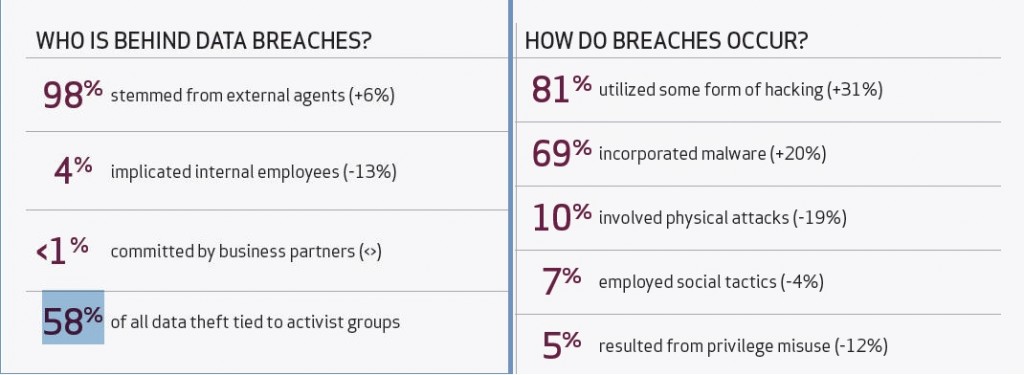
If Anonymous is perceived by future generations as an attractive ideology to follow, industry and government view with concern the threat posed by the group’s operations. The recent security reports, such as that produced by Verizon, indicates the phenomenon of hacktivism as the main threat of cybercrime planet, estimating the damage done by groups like Anonymous in their frequent operations.
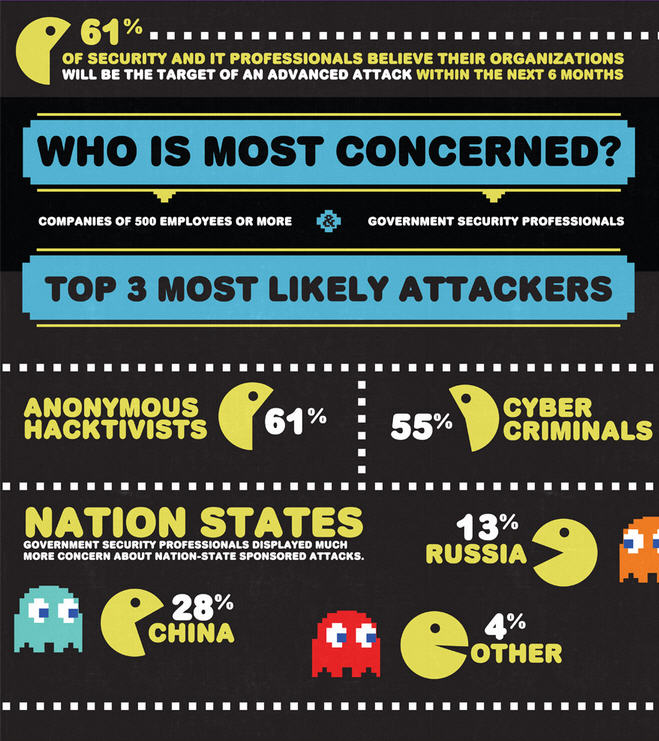
The majority of IT and security professionals is convinced that Anonymous and groups of hacktivists are main cyber threats able to attack their organizations impacting on their primary business. Around the 64% of the nearly 2,000 IT professionals who participated in Bit9′s 2012 Cyber Security Survey believe that their companies will be target of a cyber attack during the next six months and 61% of them chose hacktivists as the likely attackers.
Of course the main factor exposes companies to the threat of the group is their media exposure, the participation to the policies or international public debates on new regulations. The group has demonstrated, in my opinion a great consistency in his choice of targets, offending companies that have distinguished themselves in approaching the topics so controversial that the group is interested.  No one can be considered safe, from the provider who is willing to support the new regulations such as the Cyber ​​Intelligence Sharing and Protection Act (CISPA) to the government agency intents on pursuing questionable international policies.
But which is the method of attack that most scares the companies?

Despite the companies afraid Anonymous and hacktivism they are most worried by the usage of malware as cyber weapon instead of the classic Distributed denial-of-service (DDoS) and SQL injection attacks preferred by the notorious hackers.
On this data we can make a couple of interesting reflections:


Companies are scared of hacktivism but consider its mode of attacks not so dangerous. The fear on anonymous attacks is related to the media effect of its operations that could damage the image of the business and also to attract other criminals groups on the target.

Second point, it is expected a radical change in the modus operandi of the Anonymous group because it is attracting also many hackers and professional that are interested to its operations. The skill of the hackers is increasing and the imminent risk is that a 0-day vulnerabilities could be found and exploited by the hacktivist causing extensive damage. The scenario described is not so absurd, let’s consider in fact that many operations of the groups could be shared and approved directly by government groups of hacker under coverage. In this case the power of attack of the group could be amplified. Let’s consider also that there is the high risk of infiltrations of the groups, Anonymous could be compared to a powerful cyber weapon. In that case operations could be addressed against political targets.


Many experts are sure that behind the recent attacks to China and it’s Great Firewall there is also the support of western intelligence, same scenario in Syria and in Tibet where groups of hacktivist have provided technological support to the dissidents.
Anonymous, and foreign governments, are well informed on the impact that political scandals could have on a country like China, emblematic is the case of communist party politician Bo Xilai.

[And Julian ASSANGE’s “thermo-nuclear threat” against Rupert MURDOCH and NEWS CORP. – US/1]
Xilai, the former Chongqing party chief, was removed from it engagements in his party positions last week because with his wife, Gu Kailai, are being investigated over the murder of British businessman Neil Heywood. The news has a dramatic effect on Chinese Public opinion, for this reason immediately the government has increased the monitoring of the social media to contain the diffusion of the news. 

On the other side, groups related to Anonymous have started to attack principal government web sites trying to force the censorship wall. Just for information searches for both Bo Xilai and his wife’s name were quickly blocked on Sina Weibo, and mass censorship of comments began.

What we expect from Anonymous in the future?

Nobody in technology, nor in business, could ignore the cyber threat moved by the group and must consider it in its cyber strategy. In the same time the group have to increase its  operations and their media effects choosing more striking objectives and conducing attacks able to make more and more damage. Next steps will include most advanced attack methods such as creating malware that to exploit unknown vulnerabilities.

Anonymous must be analyzed with a multidisciplinary approach, it is an amorphous creature that quickly changes and is able to adapt its behavior to the context he need to attack thanks the large and heterogeneous participation in its collective. But do not forget that “Anonymous” due its notoriety has become the perfect scape goat, government and private industry can perform cyber attacks in the name of the groups involving critical masses.

We run the serious risk of being frightened by the entity directing our efforts against the wrong image reflected in a mirror, the result of diversions or worse of an undercover action. In my opinion this is the most disturbing aspect of the story.  How to avoid this? It’s hard to say, it is impossible to hazard a forecast. Personally, if I were part of the collective, I would begin to evaluate a social opening considering that the movement is also expression of large masses.

That is the real challenge for a movement that may die due its notoriety, but consider that the outing isn’t so simple because Anonymous has no unified voice and hasn’t a real control center.

The choice could actually split the group, giving rise to crazy cells,
impossible to control and very dangerous.

Pierluigi Paganini


[Information contained in BKNT E-mail is considered Attorney-Client and Attorney Work Product privileged, copyrighted and confidential. Views that may be expressed are those of the author(s) and do not necessarily reflect those of any government, agency, or news organization.]
 

10 May 2012

JUDITH MILLER: Egyptian Presidential Front-Runner Predicts Israeli Strike More Likely

RETURN to the BlackNET Intellignce Channel-FLASH- OPEN SOURCE

JudithMiller.com;US/1; ATTN:


NewsMax
May 10, 2012
Egypt's former foreign minister and ex-head of the Arab League who is the front-runner in the country's upcoming presidential elections, called Israel's new coalition government a "war cabinet" that could make an Israeli military strike on Iran's nuclear facilities more likely.
In an interview while campaigning in the Nile delta on Tuesday night, Amr Moussa, 75, said that because Israel's new national unity Israeli coalition government would give Prime Minister Benjamin Netanyahu an overwhelming majority in Israel's parliament, it would be a government that would take "tough" positions and might shore up Israeli support for a possible strike against Iranian nuclear facilities. "It will be a rough cabinet," he said of the new coalition government that Netanyahu unveiled on Tuesday.
But Moussa said he still hoped that Israel would not resort to military action against Teheran. "No country will stand with Israel if it takes such uncouth action," he said.
Moussa spoke with this reporter about his views of Egyptian domestic and foreign policy in an interview aboard his campaign bus while speaking to rallies throughout Egypt's traditional agricultural area.
The delta is viewed as a stronghold of the Muslim Brotherhood, whose nominee for president, Mohamed Morsi, is also seen as a leading candidate.
Tens of thousands of Egyptians poured into the streets of villages and towns to cheer him and shout their support for his candidacy. At some stops, supporters were so enthusiastic that they refused to permit his bus to leave until Moussa stepped down to speak to them, which he did in at least one unscheduled stop.
Moussa, who served as Egypt's foreign minister under ousted President Hosni Mubarak, was virtually the only one of Egypt's 13 candidates for the presidency to react to Prime Minister Netanyahu's surprise deal with Israel's main opposition party to form a national unity government.
Netanyahu's agreement with Shaul Mofaz, who leads the centrist Kadima party, gives the ruling coalition the support of an unprecedented 94 out of 120 members of the Knesset, Israel's parliament.
Egypt's transition government, appointed and heavily influenced by the Egyptian military, the country's de facto rulers, had no comment today on the new Israeli government. None of the other leading candidates in Israel's presidential race chose to comment either on the sudden and politically dramatic development in Israel, with whom relations have been tense for years.
Although Egypt was the first Arab state to make peace with Israel, relations between Egypt and the Jewish state have been increasingly strained since the mass protests that forced President Hosni Mubarak from office in early 2011.
In April, Egypt's transitional government cancelled a deal signed in 2005 in which Cairo had agreed to supply Israel with natural gas for the next 15 years. Israel has been getting about 40 percent of its gas from Egypt, which ended the contract after 14 attacks on the pipeline linking the countries.
Last September, Israel's embassy in Cairo was also attacked, along with the Saudi embassy by the Muslim Brotherhood and young protesters from Tahrir Square, the heart of the mass uprisings that ended the Mubarak regime last February.
Israel's ambassador left the country, along with most of the embassy staff and their families. Several months later, a new Israeli ambassador took up residence in Cairo, but Jerusalem has not been able to find a new office for its embassy.
Moussa, both as foreign minister and head of the Arab League, was a frequent and vocal critic of Israel, particularly of the stalemate in the Palestinian-Israeli peace process. He has also previously criticized Israel's possession of nuclear weapons, which Israel has never officially acknowledged having.
Last week, he called the Camp David peace accords between Egypt and Israel "dead and buried," and said that the agreement should be put "on the shelves of history." But an aide said that Moussa's statement did not mean that Egypt would not respect its peace agreement with Israel. "Egypt respects all of its international treaties and commitments," he quoted Moussa as saying.

[Information contained in BKNT E-mail is considered Attorney-Client and Attorney Work Product privileged, copyrighted and confidential. Views that may be expressed are those of the author(s) and do not necessarily reflect those of any government, agency, or news organization.]
 

CyBER-BlackSEC Debate

BlackNIGHT Target Practice

SEAL Team SIX - Iron Will from CBS News

The Devil's Advocate?

In 1991, [the late former Secretary of State Lawrence 'Just call me George'] Eagleburger explained to The Post why all of his sons were named Lawrence.

“First of all, it was ego,” he said. “And secondly, I wanted to screw up the Social Security system.”